"Each situation brings it's own specific requirements.
I listen, feel and respond and try to supply what the music demands"
- Adam Nussbaum

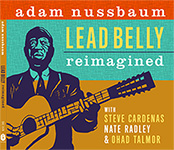 Adam Nussbaum's
LEAD BELLY reimagined
Sunnyside Records rec. 2019
Release Date August 2020
The Musicians;
Adam Nussbaum / drums
Steve Cardenas / guitar
Nate Radley / guitar
Ohad Talmor / saxophone
The Songs;
1 - Relax Your Mind
2 - Laura
3 - Princess Elizabeth
4 - Rock Island Line
5 - When I Was a Cowboy
6 - Sorty George
7 - If It Wasn't for Dicky
8 - Governor Pat Neff
|
Adam Nussbaum - LEAD BELLY reimagined
August Release 2020 Label: Sunnyside Records, 2020
Personnel – Ohad Talmor: tenor saxophone; Steve Cardenas: guitar; Nate Radley: guitar; Adam Nussbaum: drums
There are reasons aplenty for the music listening population's attention being swayed by Lead Belly. The songs that he sang were appealingly forthright and uncomplicated. His voice and powerful 12-string guitar were strong and enticing. Because of his magnetism, Lead Belly's music remains a touchstone in blues's evolution into rock, soul and jazz music. // Two years ago, Sunnyside released drummer Adam Nussbaum's first true recording as a leader, and fantastic tribute to one of his idols, The Lead Belly Project. Nussbaum's band of saxophonist Ohad Talmor and dual guitarists, Steve Cardenas and Nate Radley, ably channeled a program of Lead Belly tunes chosen by the leader, mainly culled from the Folkway Recordings 10-inch records Nussbaum grew up listening to. The project allowed Nussbaum to show another side of his musical character that he hadn't previously been able to showcase regularly during his remarkable forty-year career. // In July of 2019, Nussbam and the ensemble returned to Talmor's home studio, Seeds, in Brooklyn. They recorded with no separation between the musicians and entirely live. The musicians' comfort with the material and each other can be heard in the results, as the pieces have an emotional intimacy that goes beyond their prior efforts. The result of these recordings can be heard on their new album, Lead Belly Reimagined. - Collector's Choice Music
________________________________
Another beautiful CD collection that takes classic blues to venturesome new places, (where jazz and blues meld in fresh and growing ways), is Adam Nussbaum's Lead Belly Project, consisting of two separately released recordings: 2018's Lead Belly Project and 202's Lead Belly Reimagined, both on the Sunnyside Records label [www.sunnysiderecords.com].
Nussbaum, a drummer of ebullient flow and exploration, brings new colors to these classic Lead Belly tunes by combining his frolicking drums with the sounds of two guitars, plied by virtuosi Steve Cardenas and Nate Radley, with a glowing muscular saxophone, played by Ohad Talmor. The results are fresh and delectable: a roving curiosity of colors and metric patterns that instill these Lead Belly tunes with funky revel. The recording quality of both CDs is stunning: every instrument is captured in its true tonal colors with great clarity and tactile presence. Also, each player's image is placed in perfect three-dimensional acuity with Nussbaum's drum kit naturally anchored and focused in the soundstage - thank goodness - with no artificial, confusing lateral spread. Everything is heard crisp, tactile clear and tonally right - a sonic joy!
Focusing on the newest CD, Lead Belly Reimagined, this tight band greases these Lead Belly nuggets with cavorting fun, always keeping the blues and jazz inspiration freah and gut-thumping. Their "Rock Island Line" train gets pumping down its tracks on a shimmer of Nussbaum's glittering cymbals and brushes, (some of the truest tones for this percussion that you will ever hear!), gaining momentum until interwoven with Talmor's streaking sax. The inventions of guitarists Cardenas and Radley are spicy-sweet delights to explore: Cardenas gently shape-shifting his assured notes with sharp, angular twists (coaxing surprising colors) while Radley draws more on fleshy deep patterns and colors, blusey and pungent. On the slow-rollicking "Relax your Mind," each guitarist gets a chance to jostle and shine within Nussbaum's animated percussion while on the following cut, "Laura," the band goes into a frenetic spidery whirl, firing away on Nussbaum's quicksilver snare/cymbal combinations and Talmor's careening sax runs. The roguish "Governor Pat Noff" rocks away on Nussbaum's big pulses and the band's comic spirited runs (ending on a howl of laughter). "When I Was A Cowboy" and "If It Wasn't For Dicky" are two incandescent ballads, softly intrepid on cymbal washws, swashes of guitar colors and Talmor's ardent sax leaps and falls. This is plucky, sweet and inventive music that brings a new dimension to Lead Belly's peerless blues; intrepid, open-minded and beautiful to explore.
|
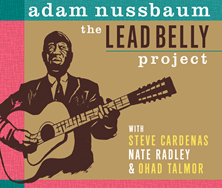 Adam Nussbaum's
The LEAD BELLY Project
Sunnyside Records rec. 2017
Release Date 23 February 2018
The Musicians;
Adam Nussbaum / drums
Steve Cardenas / guitar
Nate Radley / guitar
Ohad Talmor / saxophone
The Songs;
1 - Old Riley
2 - Green Corn
3 - Black Girl (Where Did You Sleep Last Night)
4 - Bottle Up and Go
5 - Black Betty
6 - Grey Goose
7 - Bring Me a Little Water, Sylvie
8 - You Can't Loose Me Cholly
9 - Insight, Enlight
10 - Sure Would Baby
11 - Goodnight Irene
The LEAD BELLY Project
YouTube: Black Betty
recorded @ Lunatico Brooklyn
|
Adam Nussbaum - The LEAD BELLY Project
February 20, 2018 Label: Sunnyside Records, 2018
Personnel – Ohad Talmor: tenor saxophone; Steve Cardenas: guitar; Nate Radley: guitar; Adam Nussbaum: drums
Adam Nussbaum’s profile as a drummer gained significant recognition when he stinted/recorded with Steve Swallow, John Abercrombie, Michael Brecker, Dave Liebman, and John Scofield.
On The Leadbelly Project, his first work as a sole leader, he draws from the American roots, focusing on treasured repertoire by the influential blues and folk singer/songwriter Lead Belly, but still adding a couple of kindred compositions of his own. Besides being a powerful singer, Lead Belly was a dedicated 12-string guitar strummer. Hence, the choice of two guitars to revive the rawness of his bluesy tones through an entirely up-to-date perspective doesn’t feel particularly surprising. Playing in tandem yet resorting to sweet-tempered counterpoint, guitarists Steve Cardenas and Nate Radley join the drummer in a bass-less quartet rounded out by saxophonist Ohad Talmor.
The latter excels on the first track, “Old Riley”, opening it alone and improvising concisely with a strong inside/outside concept. The tune, feeling like an indulgently polished minstrel song damped in folk charisma, has Nussbaum showing his habitual drumming sophistication, first with brushes and then with drumsticks.
Conceived as a subtle quadrangular conversation, “Green Corn” embarks on a harvesting folk dance propelled by the glistening brushwork of the bandleader. It feels more untreated than the recognizable “Black Girl (Where Did You Sleep Last Night)”, a traditional American folk song that was extensively recorded by Lead Belly between 1944 and 1948 and gained high popularity in the 90s with a terrific unplugged version by the grunge band Nirvana. Nussbaum’s version is played Frisell-style at a 5/4 tempo.
There’s something reggae-ish on “Bottle Up and Go”, but the rhythm is lost somewhere by the end to favor a more rock-based texture that is further emphasized on “Black Betty”, a standard of the blues, here buoyed up by a double-guitar solo.
Cutting off the bustle, “Bring Me a Little Water, Sylvie” and the strikingly beautiful original “Insight, Enlight” make room for contemplation, flowing with consecutive docile movements. If the latter piece, in all its harmonic sophistication and pervading sense of melody, dragged me into a levitating state, the blues-drenched “Sure Would Baby“ pulled me back to the earth. With an up-front drum solo, the classic “Goodnight Irene” closes the album in a suave waltzing cadence.
Nussbaum’s drumming has that kind of shining quality that rewards the collective and enhances the tunefulness of the music. Throbbing with marvelous interplay and filled with compelling tonal colors, this project provides us with an optimum revitalization of the folk and blues genres, here seamlessly merged with the exciting language of jazz.
Favorite Tracks:
04 - Bottle Up and Go 09 - Insight, Enlight 10 - Sure Would Baby
|
Adam Nussbaum - The Lead Belly Project
Sunnyside SSC 1500
Adam Nussbaum (d), Ohad Talmore (s), Steven Cardenas and Nate Radley (g). Rec. 27 March 2017
Those that rage against the appropriation of black music by white musicians may look askance at Nussbaum’s re-visioning of Huddie Ledbetter’s songs: but it’s an eternal testament to the blues giant’s songs that over the decades they’ve won a universality that reflects what it is to love, lose, be locked away, and yet dream, dream, dream and be triumphantly free whatever the Man does to beat you down. Not having Lead Belly’s 12-string at his disposal, Nussbaum has cunningly hired two six-string axe men, (that adds up to 12 strings, yeah?) and between them they almost equal Lead Belly’s primal power. Both get set free on an irascible take on ‘Black Betty’, though it’s Nussbaum’s outrageously spectacular rolls that upstage the guitarists. He also lays down a voluptuous intro to ‘Goodnight Irene’, now turned into a seducing waltz with Talmore’s sax sweet and bitter all at once: watch out, Irene, he’s gonna get you (Andy Robson)
_______________________________________
Adam Nussbaum: Back To Basics
by Ludovico Granvassu April 5, 2018
"Simple is not easy. As I'm getting older, I think I have a greater appreciation
for the things that move me on an emotional rather than technical level."
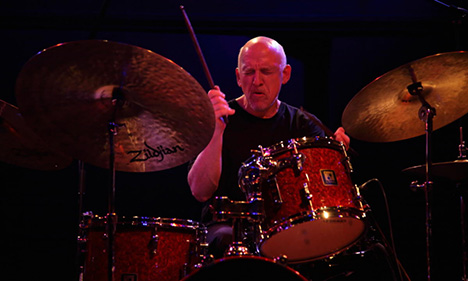 Photo Credit: David Forman
For his first album as a leader, The Leadbelly Project (Sunnyside Records), Adam Nussbaum has decided to focus on one of his first musical heroes, Huddie William Ledbetter, best known as Leadbelly. With an original line-up featuring two guitar players (Steve Cardenas and Nate Radley) and one saxophonist (Ohad Talmor) Adam Nussbaum has chosen to go on a path less travelled, putting aside for a moment his power drumming and going back to basics with a project that prioritizes communication over technique.
To listen to the music of The Leadbelly Project as well as to excerpts of this interview, play the archived podcast of Mondo Jazz (starting at 49:06).
All About Jazz: On the back-cover of The Leadbelly Project there's an image of you posing in front of your extensive record collection and next to the two Folkways albums by Leadbelly, Take This Hammer and Rock Island Line, that at a very young age sparked your love for his music. What drew you towards those albums which were part of your parents' record collection?
Adam Nussbaum: Two sides of Leadbelly emerge from the covers of those records. On one of them, he's wearing a bandana around his neck and on the other one he's wearing a suit and he holds a guitar. In my eyes as a little boy the first one portrayed his folk singer side and the other one represented his more urban side, with probably a blues connotation in there. I was fascinated by these records. I listened to them a lot.
AAJ: The blues, especially in its original form, may not be the first genre of music one may think that a five year old would be drawn to. Besides showing that you already had the genes of a musician, what was in that music that caught the attention of five-year-old-Adam?
AN: I just heard a lot of honesty and truth in that music. But it was the whole package that fascinated me. Looking at this man, listening to his music, hearing the purity of it, the honesty of it... These were old folk songs, "Green Corn," "Black Betty," "Bring Me a Little Water, Sylvie," etc. They were easy to understand for a kid of that age. Plus, I think that when you are young, you're very receptive to things. You're still open, things are still new to you. The impression that these things can make on you are more present and more powerful. At that age your mind is a sponge.
Every culture has music that speaks to our inner being, that has the visceral quality of something that you feel within you. It's not just something that is striking you intellectually or mentally. It's something that goes a little deeper and you feel in your being. Every culture has a music that has that kind of a power.
AAJ: As leader of this project how did you approach it to stay close to the spirit of Leadbelly while playing it in a very different context like that of jazz quartet with a saxophone playing the role of the singer?
AN: When you have great musicians, you don't need to give them anything complicated in order for them to create something good and express their feelings. We all know that simple is not easy. As I'm getting older, I think I have a greater appreciation for the things that move me on an emotional rather than technical level. Music is supposed to be able to take you to different places as far as how you feel.
AAJ: Is this interest towards the blues something that may reflect a desire for stripping things down, a quest for simplicity in a world like jazz which is often unnecessarily brainy or complicated?
AN: Foundations don't change. They transcend genres and eras. Nobody's complaining about Bach saying he sounds old fashioned. There is a certain quality that gets you. When you hear different people interpret that music, like Pablo Casals playing the "Cello Suite" for instance, you do feel something. In the music of Leadbelly I saw a vehicle that would allow me to collaborate with some great musicians and hopefully come up with an interesting project, because you can really feel something in Leadbelly's songs.
AAJ: How did you come up with this original line up with a saxophone, two guitars and no bass?
AN: I wanted to try to do something a little outside of the box that I'm normally associated with. That's why I decided to utilize this instrumentation with a saxophone and two guitars instead of using a more conventional line up with maybe a bassist. After all, Leadbelly played the 12 string guitar, so I thought it would make sense to have two wonderful six string guitar players [Laughs -Ed.]. Ohad Talmor, Steve Cardenas and {Nate Radley} are all musicians that are first of all very good listeners and know how to react and respond to each other. That's of paramount importance.
I knew Ohad quite well and I had heard Steve and Nate on the scene and I was sure they would have a good point of view. I really gave them very little direction. That's why I picked them out, because I trusted their intuition and their abilities as musicians. A great band leader tries to get people around him that know what to do and respects their opinion. The best thing a band leader could say to his band is nothing. That's because the band leader should trust what each band member brings to the table. Every time we have played together there has been a sense of discovery. It is an ongoing journey and I think that's something that happens when you have good people that are working together towards a common goal. We all have an understanding of tradition, but we're also not handcuffed to it and we're not afraid to take risks. And I think that that's a very important aspect of what improvised music is about.
AAJ: Even though you've been one of the most active players on the jazz scene for decades, The Leadbelly Project is your first project as a leader. How does being the leader of the project, instead of co-leader or band member, influenced how you approached this recording session?
AN: I don't think it really changed anything. My job has always been to help everybody to play as well as possible, to serve the music. And that means to serve the individuals. If I was playing this music with some different people, I would probably have a different way of interpreting what's going on.
I already organized other projects in the past. You get the repertoire together then you go into the session, you discuss with the band what works and what doesn't. I am very democratic. I listened to what the other gentlemen had in mind and we tried to work together as a group. It's basically a democracy. Maybe I'm the dictator of this democracy, but I didn't change anything in the way I would play on a project. I basically have always tried to let the music inform me. I've always considered myself the third component in the chain. The first thing is the music and then the second component are the individuals and how they interpret that music. And my task is to fulfill what that music and their conception requires.
AAJ: The album sounds like an organic whole and not a collection of songs put together. How did you select the songs for this album from Leadbelly's repertoire?
AN: I tried to also let this project have a feeling where the first song is the start of journey, not unlike that which you embark upon with the first chapter of a book. After all, I belong to an analog generation, we listened to vinyl, we didn't download invididual songs. The first track was the beginning of a story, at the end of the first side there would be a chance for you to catch your breath, turn the record over, and then go on the next chapter and the next part of that whole adventure. And finally the last track would end in such a manner to help bring everything together.
For this album I wanted each tune to be not too long and be able to represent a little chapter in an adventure, in a story. I included songs that I remembered from those two records of Leadbelly that we discussed at the beginning. They are burnt deep within my DNA. I also added some of my compositions, which I thought had a nice simple quality that and would therefore lend themselves to being along with these songs made famous by Leadbelly. "Sure Would Baby," which is my wife's nickname, she's a real treasure for me, and "Insight, Enlight."
|
Nussbaum plays Lead Belly, updated with
new quotes from the drummer composer
by Marlbank January 20, 2018
A must-hear blues and folk loving 23 February release for The Lead Belly Project, new on Sunnyside from revered Impossible Gentlemen drummer Adam Nussbaum, is in the offing.
Adam, highly respected for his work dating back to the late-1970s career of John Scofield and who has also enjoyed a long performing and recording association with the great Steve Swallow including the bass guitarist-composer’s erstwhile tenure in the Gents, is promoting the album on Facebook and says: “We play The Jazz Standard on Feb 27 in NYC.” In the playing company of Ohad Talmor, saxophone, who recorded the album and collaborated closely on it with Nussbaum; Steve Cardenas, six-string guitar and Nate Radley, also six-string guitar. Nussbaum’s band are all [viewable top] in the video.
Tracks, a few of which are listenable to on Bandcamp, are: Old Riley; Green Corn; Black Girl (Where Did You Sleep Last night); Bottle Up and Go; Black Betty; Grey Goose; Bring Me a Little Water Sylvie; You Can't Lose Me Cholly; Insight, Enlight; Sure Would baby; and Goodnight Irene. Recorded by Ohad Talmor in a Brooklyn performance space last year in a single day, classic Huddie Ledbetter songs plus two Nussbaum originals, Enlight and Sure Would baby are included.
Updated 21 March 2018:
I got in touch with Adam who kindly answered a few quick questions. To kick off: how did the Jazz Standard gig in February go?
"It was a good night! A pleasure to play with these musicians."
What did you play that night and what's next for the project?
"we played the songs from the CD. We'll see what's next :-)."
And what about how you and Ohad Talmor work together?
"Very well... He's a fantastic musician," Adam wrote via e-mail.
One thing that puzzled me was that 'Rock Island Line,' a big hit in the UK and Ireland for Lonnie Donegan and the Chris barber Jazz Band in 1955 certified gold heralding a craze for skiffle, wasn't on the album. So I asked, why not?
"we did what we did," the pithy response.
On another subject does he have any future plans for the Impossible Gentleman?
"I hope we play again. Right now other commitments are being fulfilled." SG
|
Adam Nussbaum's THE LEAD BELLY PROJECT
From Adam Nussbaum's The Lead Belly Project
(Feb. 23, 2018) on Sunnyside Records
From jazz and soul to rock and country, the blues are the bedrock and a uniting feature for much of the popular music originating in the United Sates. The simple and repetitive structures are easy to grasp and perform, making the blues extremely approachable. Under the command of brilliant writers like the legendary Leadbelly, the blues maintains a unique place between high art and common expression.
The discovery of the music of Leadbelly was transformative for young Adam Nussbaum. The only child of artistic parents in Norwalk, Connecticut, Nussbaum was exposed to many recordings, from classical to folk to jazz and blues. It was the image of Huddie Ledbetter on the original Folkways 10-inch record covers that fascinated the five year old. The celebrated blues and folk musician’s music seared itself into his ears, as it does in young listeners, informing the future drummer’s musical approach for years to come, most explicitly on his new recording, The Leadbelly Project.
Nussbaum studied classical piano for five years, but it wasn’t until he was twelve that he focused on drums. He played in local bands before moving to New York to study at the Davis Center at City College. Most of Nussbaum’s education was earned by sitting in with other musicians and it wasn’t long before he caught the attention of the City’s most notable players, including Dave Liebman and John Scofield. His professional career began as he left school to go on tour with Scofield. He has remained a first call drummer over the past 30 years, playing alongside legends like John Abercrombie, Gil Evans, James Moody, Stan Getz, and many others.
Nussbaum has had a long association with bassist Steve Swallow, through whom he met saxophonist/composer/arranger Ohad Talmor, who then became a great friend and collaborator. It was Talmor who suggested that Nussbaum begin a new project. It was for this that the drummer decided to revisit some of the music that inspired him early on, specifically the music of Leadbelly. Nussbaum found that the simplicity and clarity of Leadbelly’s songs provided many possibilities in interpretation. It was only a matter of finding the right voices to fill out an ensemble.
For his quartet in addition to Talmor, Nussbuam decided to eschew the bass and employ two electric guitarists (two six stringers for Leadbelly’s single 12-string guitar) whose only requirements would be to be open-minded, stay out of each other’s way and be supportive of the music. Steve Cardenas was an obvious choice as Nussbaum had been a fan of his playing and felt that he would be receptive and sensitive to this melding of jazz, blues, and folk. Nate Radley was a perfect foil for Cardenas and a sensitive listener who could bring much to the music.
_______________________________________
Adam Nussbaum: The Leadbelly Project
(Sunnyside) Ken Micallef
Performing the songs of the legendary folk singer Leadbelly with a quartet of drums, saxophone, and two guitars creates a joyous sound that is as pleasurable as it is cleansing.
A Leadbelly fan as a child, Adam Nussbaum wisely omits bass guitar on his new recording as a leader, lending the music an elastic buoyancy while also allowing his drums to shine, a revelation free from lower-frequencies. Anyone over the age of forty will know these Americana standards, including “Black Betty,” a 1977 hit single (with revised lyrics) by the New York City rockers Ram Jam. Each song, from “Bottle Up and Go” to “Green Corn,” floats and unfurls, radiating the elation of improvisation with melody at its core. Nussbaum masterly prods and pokes the performers, with sticks and with brushes, his big swing beat a consistent delight.
_______________________________________
THE BEST JAZZ ON BANDCAMP
Adam Nussbaum - "The Lead Belly Project"
A project that embraces the songbook of legendary blues musician Lead Belly makes perfect sense in the context of a jazz recording. Blues is at the core of jazz—in some cases, it practically radiates to the fore. The emotional depth of a Huddie Ledbetter tune acts as a compelling counterweight to its crisp melodic straightforwardness. Adam Nussbaum recognizes this, as well as the fact that the blues can manifest in any number of emotional reactions. It’s a pure joy that, on The Lead Belly Project, he’s chosen an approach to the music that is so laid-back it borders on contemplative. Whether the drummer is kicking up a little dirt on “Sure Would Baby” or wistfully sighing out a rendition of “Bring Me a Little Water, Sylvie,” the songs paint a picture of a band stretching out late at night on a porch, performing for the crickets, the trees, and the moon.
_______________________________________
NOTES ON JAZZ
Drummer Adam Nussbaum's "The Lead Belly Project"
by Ralph A. Miriello
February 25, 2018
The drummer Adam Nussbaum is one of those journeyman percussionists whose grounded beat can be heard on over one hundred-seventy recordings. He has worked with the likes of John Abercrombie, Michael and Randy Brecker, Jerry Bergonzi, Steve Swallow and Carla Bley to name just a few. I have always found his work to be interesting, if slightly under the radar, and was particularly impressed with his work in his band BANN with saxophonist Seamus Blake, bassist Jay Anderson and guitarist Oz Noy from back in 2011.
As a youngster growing up in Norwalk. CT, Nussbaum became exposed to the music of the folk/blues artist Huddie William Ledbetter, better known as Lead Belly, from his parents record collection. The music inspired young Nussbaum but as he says “…he listened, loved and forgot those old recordings.” It was a long time coming, but the drummer decided to assemble a group of like-minded musicians and dedicate a record to this legendary folk/blues artist, one who left such a lasting impression on him during his formative years. The Leadbelly Project is a project that honors the music of Americana as represented by the music of Ledbetter. There is a deeply authentic feeling that this music elicits and it is only enhanced by the musicianship and fervor that these four artists bring to this endeavor.
Recorded in Brooklyn in March of 2017, Nussbaum garnered the services of two guitarists, Steve Cardenas and Nate Radley, and one saxophonist, Ohad Talmor. Led by Nussbaum’s agile drums, these guys re-invigorate the simple but powerfully moving blues/gospel based-folk music of Lead Belly. They inject their own sensibilities into the repertoire, contemporizing it and re-introducing this wonderful music to a whole new generation of listeners.
The album features seven songs composed by Ledbetter, two traditional songs “Green Corn” and “Good Night Irene” and two Nussbaum Originals “Insight, Enlight” and “Sure Would Baby.”
Just sit back and listen to these guys interact. It is a communal love fest for this fiercely original, American roots music and if you listen intently you will be transported to a simpler time.
The dual voices of Radley and Cardenas seamlessly mesh through each other’s lines without ever clashing. Saxophonist Talmor plays with admirable restraint, favoring a dedication to tone and feeling over speed. Nussbaum is clearly the leader here, but not in an overtly, out-front sort of way. The veteran drummer chooses the tempos and sets the tone, building an armature upon which his proteges can further enhance. He leaves the group plenty of room to develop their own ideas and pushes and prods as the master rhythm maker he is.
From the opening saxophone refrain of Talmor on “Old Riley” you can hear this album is about imparting a “down home” feeling. The two guitarists dance around each other in complementary fashion as the drummer adds splashes of color before the group gets into a cadenced march following Nussbaum’s brushed traps.
On “Green Corn” the musicians carry on a delicate conversation where each respond to the other’s brief statement. They eventually create a circular whirlwind of notes, the two guitarists almost indistinguishable as they play off each other’s ideas, with Talmor and Nussbaum carry the melody to a tidy coda.
The slow sauntering “Black Girl (Where Did You Sleep Last Night) creates room for Cardenas and Radley to create a Frisellian atmosphere drenched in picked and strummed twang over a 5/4 beat.
There is head-bopping authenticity of the group’s “Bottle Up and Go” that makes it a real treat. Listen to Nussbaum’s dancing calliope of sounds as he works his kit to great effect. Talmor’s saxophone lazily lopes along in perfect harmony with the rest of the band. The guitar work is so integrated into the music that it’s hard for me to distinguish who is playing what here, but no matter it all sounds fluid and right.
The album continues with other Lead Belly classics like the rousing “Black Betty,” a funky sort of vamp with a nice solo by Cardenas; the short, angularly played “Grey Goose” which has a sweet drum intro by Nussbaum, and the gospel-like “Bring Me A Little Water, Sylvie” which features some country-inspired guitar work and some dreamy saxophone by Talmor. The shaking “You Can’t Lose Me Cholly” is a joyful tune with Nussbaum adding a lot of color to the rambling song.
“Insight, Enlight” is a gentle gem. It starts with a light, finger-picked guitar intro that hangs in the air like the sound of a wind chime in a gentle breeze. Nussbaum’s shimmering cymbal work and the hauntingly tenor of Talmor stating the repeating melody line further enhance the solemnity of this beautiful miniature.
The easy shuffling of Nussbaum’s “Sure Would Baby," is a song Adam wrote for his wife and is just plain fun to listen to. You can hear the group take this one and make it their own.
The set closes with the classic “Good Night Irene.” Nussbaum opens with a tom-based drum intro that leads into the melody stated simply by Talmor’s tenor as the two guitarists weave their lines into a filigreed pattern.
(YouTube) Adam Nussbaum's LeadBelly Project - Black Betty
_______________________________________
Adam Nussbaum: The Lead Belly Project
By Dan McClenaghan
December 19, 2017
The blues is simple music. What do they call it? Three chords and the truth? They say the same about country music and rock, but that's another article. But for much of American music, blues is the bedrock, be it rock, soul, funk, a good slice of country western, and, yes, jazz.
Drummer Adam Nussbaum zeros in on the blues with the Lead Belly Project, exploring the seminal delta blues of Huddie Ledbetter (1888-1949), aka, Lead Belly.
An inspirational artist, Lead Belly has found its way into jazz explorations often. Saxophonist Clifford Jordan went there in a big way with These Are Our Roots: The Music of Lead Belly (Atlantic Records, 1965); and saxophonist Geof Bradfield—inspired by Lead Belly via Jordan, presented in 2015 the excellent Our Roots (Origin Records).
Lead Belly was one of the smoother, more polished of the delta blues artists (it is, of course, relative), his sound less raw than those of Robert Johnson, Charlie Patton or Son House. Interestingly, Nussbaum and his cohorts lean toward the raw side with their takes on Some of LeadBelly's best known tunes. It's two guitars, Steve Cardenas and Nate Radley, joined by saxophonist Ohad Talmor and drummer/leader Nussbaum, immersed in the glorious simplicity of the music. Talmor's sax has restrained, rough-around-the-edges sound at times, and a big, holy, resonant tone at others. The guitar-manship is refined, luminous—a country twang sneaks in on "Bring Me A Little Water, Sylvie." They have a rockabilly feel on "Black Girl (Where Did You Sleep Last Night)."
As rough hewn as this quartet's renderings are this music, there is also a deft exquisiteness to it. A loose, spontaneous, soundtrack to America feeling, with top level musicianship involved in the serving up elemental sounds.
Track Listing: Old Riley; Green Corn; Black Girl (Where Did You Sleep Last Night); Bottle Up And Go; Black Betty; Grey Goose; Bring Me A Little Water, Sylvie; You Can't Lose Me Cholly; Insight, Enlight; Sure Would Baby; Good Night Irene.
Personnel: Adam Nussbaum: drums; Steve Cardenas: electric guitar; Nate Radley: electric guitar; Ohad Talmor: saxophone.
Title: The Lead Belly Project | Year Released: 2017 | Record Label: Sunnyside Records
|
 Let's Get Deluxe
Basho Music - July 2016
1 Let's Get Deluxe . . . . . . . . . . . . . . . . . . . . 6:05
2 It Could Have Been a Simple Goodbye . . 7:31
3 A Fedora for Dora . . . . . . . . . . . . . . . . . . . 8:21
4 Miniature . . . . . . . . . . . . . . . . . . . . . . . . . . 2:26
5 Terrace Legend . . . . . . . . . . . . . . . . . . . . . 8:38
6 Dog Time . . . . . . . . . . . . . . . . . . . . . . . . . . 6:10
7 Hold out for the Sun . . . . . . . . . . . . . . . . 6:40
8 Intro to Propane Jane . . . . . . . . . . . . . . . . 0:40
9 Propane Jane . . . . . . . . . . . . . . . . . . . . . . . 6:06
10 Speak to Me of Home . . . . . . . . . . . . . . . 7:07
|
The Impossible Gentlemen
Let's Get Deluxe (Basho Music)
Exuberance, humour and adventure - Review by Martin Critchley
This album has excelled my expectations. From previous albums I was expecting bright improvisations, a sense of humour and coming through everything, the sheer exuberance and enjoyment of these gentlemen playing together. I got all that and much more.
The emotional power of tracks such as 'Wallenda's Last Stand' ('The Impossible Gentlemen') and 'Just to see You' ('Internationally Recognised Aliens') has been augmented by additional instruments. This is not to say that '. . . Simple Goodbye' is crowded - far from it.
There is a deft touch to the orchestrations that gives a new dimension to the group dynamic. And this band can rock! 'Play the Game' developed into 'Barber Blues' and now 'Propane Jane' will blow you away!
The whole album repays repeated listening for the use of dynamics and the tones and textures of the new instruments. There might even be the judicious use of an effects pedal on the bass at one point . . .
If you like your jazz adventurous, with a sense of humour and truly moving improvisations, then this is the group for you. Don't get just this album - get all three.
|
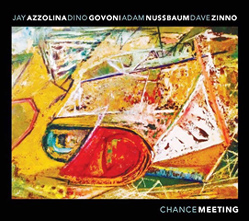 AGNZ - Chance Meeting
Whaling City Sound rec. 2016
|
Azzolina Govoni Nussbaum Zinno
Chance Meeting (Whaling City Sound)
Jay Azzolina - guitar
Dino Govoni - saxophone
Adam Nussbaum - drums
Dave Zinno - bass
|
 Flying in Circles
NDR Records
* Released 2015
1 Adam's Ale . . . . . . . 7:45
2 7 in 7 . . . . . . . . . . . . 7:47
3 Breeze . . . . . . . . . . . 6:46
4 Flying in Circles . . 11:11
5 Nocturne . . . . . . . . . 9:04
6 Ivan's Song . . . . . . . 8:09
7 Woodzling . . . . . . . . 6:30
All tracks feature Adam Nussbaum
|
Christian Elsässer & NDR Big Band
Flying in Circles (NDR)
All music composed and arranged by Christian Elsässer
(text translated) Composing music is a very personal matter, but also technical and logical. Finding a balance between the two, the composer creates music that enchants. Munchner pianist and composer Christian Elsässer managed together with the NDR Big Band on the CD "Flying in Circles". Everything clearly works: catchy melodies, powerful sounds. Music composed very precisely. Despite concentrated density, the music also has width. With air under his musical wings, the music is carried off through his compositions. Easy, free, wild and unbridled. He succeeds dense and airy at the same time - to compose with the head and from the gut.
|
Christian Elsässer, born in 1983 in Munich, is an ECHO Prize winner, Germany's demand as a pianist and worked in various areas as arranger and conductor: In cooperation with all German radio big bands and in projects with the Munich Philharmonic, the Munich funk orchestra and singer-songwriter Willy Astor he looks beyond the boundaries of jazz. On the CD "Flying in Circles" the NDR Big Band developed under the direction of Jörg Achim Keller with her outstanding soloists, the American guest star Adam Nussbaum on drums and the composer of the pieces Christian Elsässer at the piano, an irresistible attraction. Adam Nussbaum, an ideal candidate for this co-operation, drives the compositions ahead with transparent energy. The human voice as an instrument set, dazzling percussion colors, flutes, clarinet, trumpets and trombones, all enriches the big band sound. Music with density and size, music played with technical perfection and lifeblood. Christian Elsässer has composed music that enchants for his CD "Flying in Circles".
Ulrich Habersetzer, Bayerischer Rundfunk
|
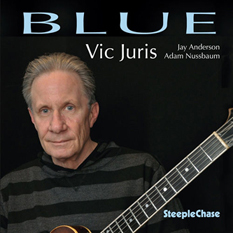 BLUE Steeplechase
New York, March, 2014
|
Vic Juris
BLUE (Steeplechase)
Vic Juris, guitar
Jay Anderson, bass
Adam Nussbaum, drums
|
1 Lonely Woman
2 What's Goin' On
3 Ugly Beauty
4 Tereza My Love
5 The Wrong Blues
6 All the Things You Are
7 Slow Hot Wind
8 Blue
9 I Wish I Knew
10 Remembering the Rain
|
 Singular Curves
Auand Records, 2014
* Released August 2, 2014
1 It Did . . . . . . . 4:25
2 Ups and Downs . . . . . . . 5:59
3 Carolina Moon . . . . . . . 5:12
4 Get Lost . . . . . . . 4:38
5 Then Again . . . . . . . 2:52
6 Meli Melo . . . . . . . 6:25
7 Now Four 2 . . . . . . . 2:43
8 7 Things . . . . . . . 6:01
9 Parallel Fifths . . . . . . . 2:05
10 Flight to Missoula . . . . . . . 4:19
11 Anything You Want . . . . . . . 3:18
12 Warp . . . . . . . 1:24
13 You Go to My Head . . . . . . . 7:04
|
SWALLOW / TALMOR / NUSSBAUM
Singular Curves (Auand)
The conventions of the tenor saxophone trio — consisting of sax, bass and drums — have held remarkably steady since Sonny Rollins brought them into popular usage in the late 1950s. Within those parameters, even a tweak can feel like a push against established precedent.
For the tenor trio Swallow/Talmor/Nussbaum, the difference has everything to do with a single member: Steve Swallow, whose style on five-string electric bass, a matter of stretch and sinew, has been refined over more than 40 years. The dark, wormy dimensions of his sound give the trio its defining trait on some of this album’s tracks, like his own “Get Lost,” a catchy tune with a rhythmic trapdoor, and “Ups and Downs,” by his longtime partner, the pianist Carla Bley. (They have played it together for a while in a drummerless trio with the saxophonist Andy Sheppard.)
|
But it’s the easy chemistry among Mr. Swallow and his band mates, the tenor saxophonist Ohad Talmor and the drummer Adam Nussbaum, that gives “Singular Curves” its claim to singularity. The trio has released one previous album: “Playing in Traffic,” its appealingly loose debut, on the Italian label Auand. This follow-up sharpens the band’s focus, with a program of mostly original music in a swinging postbop mode.
Mr. Talmor, whose dry but expressive sound on tenor can evoke Joe Lovano, has a knack for writing sturdy but pliable compositions: “Meli Melo” is a tone poem in a gracefully halting cadence, while “7 Things” spins neat arabesques over the chord sequence for the standard “All the Things You Are.” “Flight to Missoula” briefly enlists the members of the trio as three strands in a braided counterpoint.
Mr. Nussbaum has his own proven rapport with Mr. Swallow, present at every turn on the album and highlighted on a spontaneous invention titled “Now Four 2.” But there’s no dominant hierarchy in the band, which will play a pair of album-release shows on Wednesday at the Jazz Standard. Trios usually call up triangular metaphors, so the suggestion of curvature in this album’s title feels like a subtle subversion.
New York Times August 11, 2014 by Nate Chinen
|
THE IMPOSSIBLE GENTLEMAN
Gwilym Simcock Mike Walker Steve Swallow
Steve Rodby Adam Nussbaum
 Internationally Recognised Aliens
SRCD432 * Released Sept. 2, 2013
AVAILABLE NOW - SRCD432
1 Heute Loiter . . . . . . . 7:44
2 Just To See You . . . . . . . 7:35
3 Modern Day Heroes . . . . . . . 6:33
4 The Silver Of Other Lovers . . . . . . . 6:21
5 Crank Of Cam Bay . . . . . . . 9:11
6 Love In Unlikely Places . . . . . . . 4:46
7 Barber Blues . . . . . . . 5:31
8 Ever After . . . . . . . 9:15
9/09/2013 Peter Bevan, Northern Echo
"Punchier and often more exciting than their debut..."
12/09/2013 Tom Henry, Toledo Blade
"One of the best combos on the planet." Read Full Article
13/09/2013 Irish Times 4 stars * * * *
"This league of extraordinary gentlemen is a more balanced act, a conversation of equals that has deepened over time despite the varying ages of its members." Read Full Article
|
As their name suggests, The Impossible Gentlemen are no ordinary band. Crossing generational and geographical boundaries, this jazz supergroup is a special, unique experience both for the musicians and for audiences. As the band convenes relatively infrequently, every gig and every recording is a magical event that captures something once seemingly 'impossible'.
'Internationally Recognised Aliens', the band's second album, finds them branching out yet further, taking new risks and making music that is adventurous, accessible and tinged with sometimes surreal humour. In addition to the established quartet of Gwilym Simcock, Mike Walker, Steve Swallow and Adam Nussbaum, 13 Grammy award-winner Steve Rodby now takes on a greater role, serving as producer and playing bass on two tracks. Steve Rodby has been part of the band for over a year, touring with the group. He brings a wealth of ideas and experience from his long career working with Pat Metheny and Lyle Mays.
Three tracks (Modern Day Heroes, Heute Loiter and Love In Unexpected Places) are co-writes between Simcock and Walker. Both of these excellent musicians are used to more auteurist compositional scenarios, so this collaborative process took the musicians away from their comfort zones and kept the music sounding fresh and exciting. Sometimes this was a matter of Walker adding key detail to a virtually completed Gwilym Simcock tune (Modern Day Heroes), at others (Love in Unexpected Places), the pieces emerged naturally from rehearsals. Walker's interest in blurring the lines between jazz, rock, pop and classical music is an ever-present feature, creating a new whole from these tried and tested forms.
Humour is also a hugely important aspect of this album's idiosyncratic character. Heute Loiter begins with Mike Walker grappling for the right sound on his guitar, whilst Crank of Cam Bay was inspired by one of Steve Swallow's stories about a man whose hideaway vacation home is interrupted with the sounds of marauding hoards of tourist families and whom he heckles with a megaphone. It features the voice of Swallow himself.
Whereas much of the music contained on the band's debut had been written before the group had even been formed, all the music for 'Internationally Recognised Aliens' was penned with this particular ensemble in mind. Just To See You even presented a rare opportunity to implement the procedure known as 'Steve Squared', with Steve Swallow playing the melody and Steve Rodby underpinning the groove.
This is honest, joyful music that tells a strong story and takes the listener on a journey. The music is also unpredictable and exciting, offering different spaces for improvisation rather than the usual theme and improvising sequence. A key aspiration for the band is longevity, and they seem poised to succeed - this is music that stands to be listened to repeatedly, yielding new surprises and greater detail with every play.
|
 Migration
FMRCD346 - FMR Records, 2013
* Released April 12, 2013
|
Jiannis Pavlidis - guitar
Adam Nussbaum - drums
George Kontrafouris - organ
Available now on FMR Records
1 Counter Fury . . . . . . . 6:43
2 Migration . . . . . . . 4:16
3 Brother Charles . . . . . . . 5:13
4 Track Info . . . . . . . 9:01
5 Sco Away . . . . . . . 8:20
6 Lisbon . . . . . . . 6:18
7 Darm That Dream . . . . . . . 6:10
PAVLIDIS NUSSBAUM KONTRAFOURIS
This truly fantastic International trio has been touring since 2007 and have finally released their first CD which certainly doesn't disappoint - with great tunes, great grooves and stunning solos from all.
|
Featuring Swedish born Greek Jiannis Pavlidlis on guitar, Greek compatriot Giorgos Kontrafouris on organ and the virtuoso legandary American jazz/fusion drummer Adam Nussbaum.
They are well established musicians with extensive profiles and each member enjoys a distinguished and varied musical life with an impressive list of personal achievements.
The musical approach the trio follows is open with a strong reference on groove. The material is mostly original as well as reworked standards with a new twist, and refreshingly quirky arrangements.
During the last tour (March 2011) the trio decided to record their first album, a decision made due to the natural chemistry between the three musicians.
|
 |
1 Remember (Steve Swallow) 6:04
2 Amazing (Steve Swallow) 7:38
3 In f (Steve Swallow) 4:26
4 Free Ballad #1 (Liebman-Nussbaum-Swallow) 2:52
5 My Maia (Adam Nussbaum) 8:52
6 Get Out Of Town (Cole Porter) 6:34
7 Bend Over Backwards (Steve Swallow) 7:28
8 Swallowish (Dave Liebman) 6:14
9 Free Beguine #1 (Liebman-Nussbaum-Swallow) 3:01
10 Sure Would Baby (Adam Nussbaum) 5:10
11 Latin Like (Dave Liebman) 5:12
* Recorded at Jay Andersons' Studio,
New York, June 21, 2010
|
We3 Amazing 10045 - Kind of Blue Records, 2011
Dave Liebman soprano & tenor sax, flutes
Adam Nussbaum drums
Steve Swallow bass
Available now in record stores and on iTUNES
Liebman, Nussbaum and Swallow have played together, on and off for over 30 years. They decided to celebrate this by writing 10 originals for this project - the other cut is a Dave Liebman arrangement of Cole Porter’s “Get Out Of Town” - where they explored the boundaries of modern jazz composition. Writing for a chordless trio was challenging in its own right but as Dave Liebman puts it: “When you play with musicians of this calibre, there is little difference from playing set pieces to playing free improvisations.
|
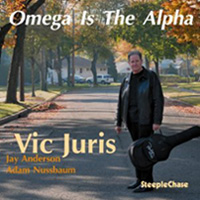 Vic Juris: guitar
Jay Anderson: bass
Adam Nussbaum: drums
|
Vic Juris Omega Is The Alpha
Vic Juris
Jay Anderson
Adam Nussbaum
Record Label: Steeplechase
1 Folksong (Vic Juris) 6:30
2 Hallucinations (Bud Powell) 5:00
3 For Shirley (Vic Juris) 7:19
4 Omega Is The Alpha (Albert Ayler) 5:33
5 Subway (Vic Juris) 6:08
6 Romulan Ale (Vic Juris) 8:27
7 Lonely Woman (Ornette Coleman) 6:04
8 Sweet Sixteen (Vic Juris) 7:18
9 Rosario (Vic Juris) 6:49
10 Alone Together (Arthur Schwartz) 6:47
|
Vic Juris: Omega Is The Alpha
BANN: As You Like
by Terrell Holmes
Bassist Jay Anderson and drummer Adam Nussbaum have played on many fine recordings as sidemen and leaders and rank among the best on their instruments. Their work on a pair of new albums validates their talent and versatility further.
Anderson and Nussbaum join guitar maestro Vic Juris on his album Omega Is The Alpha, a set of originals and standards. Juris’ lovely acoustic Latin-themed tunes “Subway” and the sensual tango “Rosario” flamenco sketches move at a relaxed, leisurely pace. Nussbaum strikes just the right chord with sticks on edge of snare and brushes on cymbals while Anderson plucks with a soft luminosity. They deftly navigate the melodic minefield Juris lays down on “Romulan Ale” and swing effortlessly on “Sweet Sixteen”. Juris uses distortion and humpback whale effects to underscore the theme of Bud Powell’s “Hallucinations”. Nussbaum thrashes, Anderson pulsates and Juris adds more synth on the Albert Ayler-composed title cut, which has an Irish folk song edge to it. Nussbaum’s lush cymbals and Anderson’s deep tissue plucking enhance an excellent version of Ornette Coleman’s “Lonely Woman”, which Juris imbues with a Middle Eastern feeling that gives it a fresh dynamic.
|
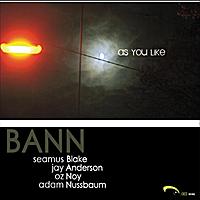 Seamus Blake: tenor saxophone
Oz Noy: guitar
Jay Anderson: double bass
Adam Nussbaum: drums
- by Peter Bacon The Jazz Beakfast
- by Bruce Lindsay allaboutjazz.com
- by S. Victor Aaron allaboutjazz.com
|
BANN As You Like
Seamus Blake
Jay Anderson
Oz Noy
Adam Nussbaum
Record Label: Jazzeyes
1 All The Things You Are (Jerome Kern) 6:35
2 Played Twice (Thelonious Monk) 6:53
3 Guinnevere (David Crosby) 8:20
4 Will Call (Jay Anderson) 3:54
5 Days Of Old (Adam & Maia Nussbaum) 4:50
6 As You Like (BANN) 6:27
7 At Sundown (Jay Anderson) 5:52
8 Minor Shuffle (Oz Noy) 7:15
9 Isotope (Joe Henderson) 8:03
- by Steve Elman Fuse Jazz Review
- by Stuart Derdeyn Quick Spins
- by Richard B. Kamins Step Tempest
|
Anderson and Nussbaum are also members of the group BANN, along with guitarist Oz Noy and sax man Seamus Blake. Their album As You Like, though having different energy, relies on the same balance of originals and standards as Omega Is The Alpha. It begins with an uptempo, postmodern reading of “All the Things You Are”, where Noy plays a blues-heavy, distorted electric guitar with organ effects. The band’s various tempo switches give Monk’s “Played Twice” a humorous touch, along with Anderson’s bold pizzicato, Noy’s guitar grunts and organ highlights and Blake’s soaring sax. Anderson’s down-in-the-soul plucking and Nussbaum’s shimmering cymbal flourishes form a grand intro to the lush “Guinnevere”, where Blake’s tenor at times has the texture of an oboe. Noy’s angry guitar, Anderson’s funky pizzicato, Blake’s blistering tenor and Nussbaum’s polyrhythms all drive Joe Henderson’s “Isotope”. Anderson and Nussbaum are also excellent composers. Anderson’s energetic “Will Call” has a raindrop-dodging melody and dynamite interplay between Noy and Blake. “At Sundown” is a rich Delta blues whose end-of-the-day languor is highlighted by Noy’s steel guitar mimicry. Nussbaum, with an assist from his daughter, Maia, contributes the soothing ballad “Days of Old”.
Both albums are solid works that provide more proof of the impressive talents of Anderson and Nussbaum.
|
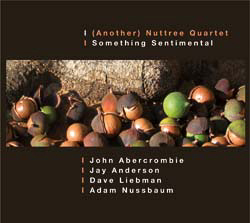 |
(Another) Nuttree Quartet
Something Sentimental
JOHN ABERCROMBIE
JAY ANDERSON
DAVE LIEBMAN
ADAM NUSSBAUM
Kind of Blue Records, 2009
Available now in record stores and on iTUNES
|
Something Sentimental Note by Adam Nussbaum
This special project came about in 2007. In May, we all played together for a party to honor my mother Muriel, who had passed away in April at the age of 83. My Mom had always said that she wanted a celebration, not a funeral. Family and friends gathered together to reminisce and we played songs that my Mom had enjoyed throughout her life.
It was an emotional time; and it was so nice to make music with these wonderful musicians, as we have been treasured friends for over 30 years. Because it felt so good, we decided we should record.
This is dedicated to the memory of our dear parents -- John & Elizabeth Abercrombie, Kenneth Anderson, Leo & Frances Liebman, Erv & Muriel Nussbaum, and those incredible people who have touched our lives. The list is long... they live on in our hearts. I not going to talk about the music. It simply is what it is. I hope you enjoy "Something Sentimental".
|
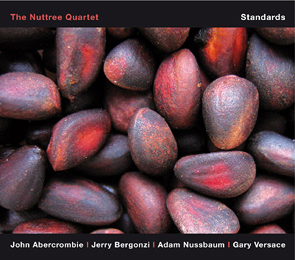 |
The Nuttree Quartet
Standards
JOHN ABERCROMBIE
JERRY BERGONZI
ADAM NUSSBAUM
GARY VERSACE
Kind of Blue Records, 2008
Now available at AMAZON.COM
Also available at CD UNIVERSE
|
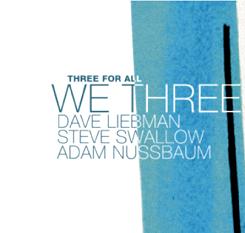 |
WE3: Three For All
DAVE LIEBMAN
ADAM NUSSBAUM
STEVE SWALLOW
Challenge Records, 2006
- by John Kelman allaboutjazz.com
- by Robert R. Calder allaboutjazz.com
- by Michael Bailey Challenge Records International
Now available at AMAZON.COM
Also available at CD UNIVERSE
|
www.adamnussbaum.com NussbaumWeb (C) 2019 mogs


We3: Amazing -- a review
Downbeat 2011
By John Kelman
There's something slightly different hearing Steve Swallow's electric bass as it fills the air of this oft times quiet and gentle album of trio jazz. It's conventional jazz but with an attitude of nothing to prove, nowhere to go necessarily, something three friends I (who've made music together for over three decades) might play just because they like to play, and play with each other.
Except for Cole Porter's "Get Out Of Town," it's all original material, everyone getting into the act and everyone getting room to blow. And blow, especially, is what Dave Liebman does here. Amazing being a great showcase for his versatility on not only his acclaimed soprano and tenor saxes but his playing in a C and wooden Indian flutes. Swallow's gentle, wooly electric bass seeps into everything here, while Adam Nussbaum's drumming is impeccably recorded and played, his approaches delicate and popping, not to mention highly syncopated with skins and cymbals alike glistening.
The jazz feel kicks in with Swallow's waltz "remember," followed by his ballad title track; Liebman sticks to soprano on both, his swinging followed by another example of his ease with Swallow's pretty melody. Another Swallow original, the perky swinger "In F," features Nussbaum's great technique with brushes. "In F," based on the chords of Cole Porter's "I Love You," is one of those free-floaters that swings with no anchor, Liebman's beefy tenor swimming in and around Swallow's high-flying bass lines. "Free Ballad #1" sounds free in a more subtle sense-what melody line there is sounds a bit structured amidst the open form. It's slightly eerie.
Nussbaum's "My Maia" (the longest cut here) is a basic medium-tempo swing waltz (alternating between 6 and 5) that lets We3 just hang out. Liebman's fire is on display, alongside some more soloing from Nussbaum, this tune showcasing his stick work. It's on a tune like "My Maia" that you can get a sense for how these three musicians feel about playing with each other: the simple melody and basic progression keeps things pretty open for three different musical personalities to inhabit. No surprises, but also no pretentious virtuosity to distract you from your basic jazz jazz conversation. "Get Out Of Town"-featuring Liebman on flute, some chatty bass from Swallow and a sultry, slow tempo-is played true to form.
The rest of the album follows a similar trajectory. Their "chordless trio" approach, while not groundbreaking, is one that's always welcome. Especially between friends.
|
We Three -- a review
All About Jazz 2006
By John Kelman
Just because artists have played with each other in other contexts doesn’t necessarily mean they will be successful when they come together as a unit for the first time. Saxophonist Dave Liebman has worked with electric bassist Steve Swallow before—most notably on Swallow’s first release as a leader, Home (ECM, 1980)—and drummer Adam Nussbaum in an early group also featuring a young John Scofield. Nussbaum has been Swallow’s drummer of choice for many years, most notably on his marvellous trio record, Damaged in Transit (XtraWATT/ECM, 2004).
But all three have never worked together before. While there’s enough individual chemistry to suggest that putting them in a room together would be a slam dunk, that's not guaranteed to be the case. Fortunately, these three don’t just work well together, they sound as if they’ve been doing it for years, making their new group We Three and its debut album Three for All as easygoing and effortless an affair as one could ask for.
Considering the strong personalities involved, what’s most refreshing about Three for All is how purely collaborative it is, reflecting each player's personality. Swallow has always possessed a dry sense of humour, and his three contributions manage to be challenging while keeping tongue planted firmly in cheek. Even his gentle ballad “The Start of Something Small” feels just the slightest bit idiosyncratic. Liebman’s cascading notes suggest greater power, but never lose sight of the delicate underpinning from Nussbaum’s brushwork. Jaco Pastorius may be most cited as the player who redefined the potential of the electric bass, but Swallow’s approach—exploiting the full range of the instrument and combining harmonically suggestive lines with more direct chord voicings—is uniquely innovative just the same, though it may not have the same panache.
Considering Liebman’s propensity for post-Coltrane expressionism, his two contributions—the metrically challenged but subdued “Cycling” and the gradually building “The Jewish Warrior”—are surprisingly understated, despite their unassailable swing. Still, his soprano solo on “The Jewish Warrior” burns as brightly as anything on the disc, and Nussbaum is right there with him, starting on brushes, but eventually switching to sticks and ultimately greater force.
Still, despite the occasional burst of heat, Three for All is so relaxed that one can forget just how potent a combination this is. Despite the drummer's energetic and telepathically locked-in support from Swallow, as well as Liebman’s leaning-to-the- extreme tenor work, Nussbaum's “BTU”—a carryover from his work in guitarist John Abercrombie’s organ trio—retains a litheness that doesn’t use that energy as a crutch, but rather a tool for organic evolution.
A pensive reading of “I Only Have Eyes for You,” a look at Miles Davis’ “All Blues” that proves you can swing in 5/4, and a wry take on Thelonious Monk’s “Played Twice” support the trio’s unhurried approach with its own material. Three for All is an album that's so inherently cohesive, it almost passes by unnoticed. But its staying power rests in the greater depth it reveals with each successive listen.
Track listing: What Time Is It; Played Twice; We 3; Up and Adam; The Jewish Warrior; Whistling Past the Graveyard; I Only Have Eyes for You; Cycling; All Blues; The Start of Something Small; BTU.
Personnel: Dave Liebman: saxophones, flutes; Steve Swallow: electric bass; Adam Nussbaum: drums.
Style: Modern Jazz/Free Improvisation
|
We Three -- a review
All About Jazz 2006
By Robert R. Calder
This is maybe my favourite Dave Liebman recording, in part because of the other two players on it. Drummer Adam Nussbaum composed the title track, and by alternating between the bass and guitar capacities of his instrument, Steve Swallow makes a little masterpiece of Liebman's creative improvisation. There's much more to it than pretty phrasing--nothing loose, perfect tension, no longueurs.
When Swallow goes all bass on his own “Up and Adam,” Liebman's tenor skips, displaying virtues associated variously with Stan Getz and Sonny Rollins; and on another Swallow number, the lyrical, midtempo “Whistling Past the Graveyard,” the tenor echoes are nearer to Ben Webster. Liebman's no chameleon; these varying resemblances just help map his exceptional personal tonal variety. He uses space, and the spaces he leaves on this number fill amazingly, with Nussbaum's alterations of dynamics and accent. Notice Swallow's walking bass on his electric instrument.
”The Jewish Warrior” starts out almost Celtic, Liebman's soprano sounding flute-toned, Swallow sounding almost Indian. “I Only Have Eyes for You,” which starts with the bassist playing his instrument like a guitar, later finds him and Nussbaum keeping things going through a virtuoso multi-note ballad performance in the line of Benny Golson, Don Byas, and Lucky Thompson. Attention to detail liberates this set from looseness, and when Liebman repeats a riff or motif, he does so with new phrasing each time.
Swallow calls upon a whole range of voices on the bass guitar. Its middle voice gets great play on Nussbaum's “Cycling.” Yet another of Swallow's compositions here, “The Start of Something Small,” could pass for an unknown Ellington ballad for Johnny Hodges. There are three terrific ballad performances here, as well as Nussbaum's riff-theme ”BTU,” a fast-medium performance surging to such a temperature that the studio fade of the last bars might have been a safety measure.
The rhythm titans provide a very full dynamic background for Liebman on Miles Davis's ”All Blues,” with a very notable train rhythm passage toward the conclusion. The duo passage on Thelonious Monk's “Played Twice,” bridging between a theme statement on soprano (something like the recently deceased Steve Lacy's classic performance on The Straight Horn) and Liebman's own very individual solo.
The last time I saw Lacy, I came away from the performance with a friend asking me, “why is jazz so satisfying?”
I'll refer him to this set.
|
We Three -- a review
Challenge Jazz 2006
By C. Michael Bailey
We Three is a trio of giants, composed of winds-fixture Dave Liebman, ubiquitous bassist Steve Swallow, and accomplished drummer Adam Nussbaum. With a line up like this, the listener might expect something a bit out of the ordinary and that is precisely what he or she gets. If Dave Liebman is in the picture, Thelonious Monk cannot be far behind, and indeed that master appears on the rarely covered “Played Twice.” Liebman’s soprano tone is sharp and tart in the head and then lazily lags into the solo, supported by Swallow’s elastic bass fiddling. The trio relationship here is more about contrapuntal interplay than ensemble performance. The players stop just short of going their separate ways and maintain the common groove.
The Monkian spirit of “Played Twice” infuses this disc with adventure and abstraction. The disc opens on a funky spunky note with “What Time Is It,” with all on board for a boisterous ride. Adam Nussbaum’s “We Three” is introduced by a lengthy soprano saxophone figure before stretching into a nuevo ballade with Steve Swallow’s signature strummed bass. When soloing, Swallow chooses a circuitous harmonic path that broadens the composition’s time. Swallow returns the favor of composition with “Up And Adam,” where Liebman plays tenor over a treacherous time signature nailed down by Nussbaum and Swallow (Monk is never far away).
The standard “I Only Have Eyes For You” is presented with a Swallow pizzicato introduction before Liebman’s tenor flows in languidly over Nussbaum’s light tom-tom play. Miles Davis’ “All Blues” is taken at a full waltz, Liebman’s soprano saxophone presenting the theme with virtuosic conviction.
Trio dates don't get much better than this one. If We Three is where the saxophone trio has come since Sonny Rollins’ trios in the late ‘50s, then the direction must be right.
|
www.adamnussbaum.com NussbaumWeb (C) 2022 Mark D McKinley